
Дофамин и глутамат у лиц с высоким риском развития психоза: метаанализ результатов нейровизуализационных исследований in vivo и сравнение их вариабельности с контрольной группой
Всемирная психиатрия. №3 2021
Дофамин и глутамат у лиц с высоким риском развития психоза: метаанализ результатов нейровизуализационных исследований in vivo и сравнение их вариабельности с контрольной группой
Robert A. McCutcheon1-4, Kate Merritt5 , Oliver D. Howes1-4
1 Department of Psychosis Studies, Institute of Psychiatry, Psychology & Neuroscience, King’s College London, London, UK; 2 Psychiatric Imaging Group, MRC London Institute of Medical Sciences, Hammersmith Hospital, London, UK; 3 Institute of Clinical Sciences, Faculty of Medicine, Imperial College London, London, UK; 4 South London and Maudsley NHS Foundation Trust, London, UK; 5 Division of Psychiatry, Institute of Mental Health, University College London, London, UK
Стр. 405-416
1066 просмотров
Опубликовано: 1 октября 2021
Аннотация / Abstract
a:2:{s:4:"TEXT";s:65527:"a:2:{s:4:"TYPE";s:4:"HTML";s:4:"TEXT";s:70335:"Предполагается, что центральным звеном патофизиологического механизма шизофрении являются нарушения дофаминергической и глутаматергической нейротрансмиссии 1-4 . С целью изучения функционирования дофаминовой системы in vivo применяются однофотонная компьютерная эмиссионная томография (ОФЭКТ) и позитронно-эмиссионная томография (ПЭТ), а количественное определение уровня глутамата in vivo возможно с помощью метода спектроскопии протонного магнитного резонанса (1H-МРС).
Метаанализы имеющихся исследований показали, что при шизофрении наблюдается усиление синтеза и высвобождения дофамина в стриатуме, а наиболее выражена данная особенность в ассоциативной области стриатума 5,6 . В отличие от этого, метаанализы исследований, изучавших доступность дофаминовых D 2 /D 3 -рецепторов, не показали значительных различий между пациентами с шизофренией и контрольной группой, несмотря на выявленную повышенную вариабельность в доступности рецепторов 6-9 .
Метаанализы исследований, изучающих функцию глутаматергической системы, показали, что у лиц с психотическим расстройством повышен уровень глутамата в базальных ганглиях, уровень метаболита глутамата, глутамина, повышен в таламусе, а концентрация глутамата в сочетании с глутамином (Glx) повышена в гиппокампе 1 . Один из последних метаанализов исследований с применением МРТ-аппарата 7-Тесла выявил снижение содержания глутамата в лобной коре головного мозга у пациентов 10 .
Эти данные свидетельствуют о дисфункции дофаминергической и глутаматергической систем при шизофрении, однако неизвестно, предшествуют ли эти нарушения началу расстройства. Для ответа на этот вопрос следует исследовать нейрохимические изменения до начала шизофрении, изучая людей с повышенным риском развития расстройства.
Хорошо изучены субклинические симптомы, предшествующие разви...
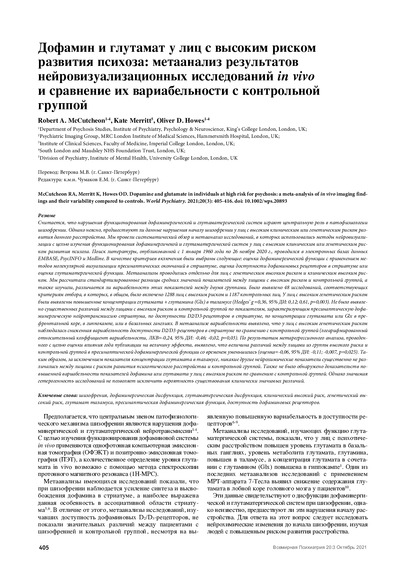
Предполагается, что центральным звеном патофизиологического механизма шизофрении являются нарушения дофаминергической и глутаматергической нейротрансмиссии 1-4 . С целью изучения функционирования дофаминовой системы in vivo применяются однофотонная компьютерная эмиссионная томография (ОФЭКТ) и позитронно-эмиссионная томография (ПЭТ), а количественное определение уровня глутамата in vivo возможно с помощью метода спектроскопии протонного магнитного резонанса (1H-МРС).
Метаанализы имеющихся исследований показали, что при шизофрении наблюдается усиление синтеза и высвобождения дофамина в стриатуме, а наиболее выражена данная особенность в ассоциативной области стриатума 5,6 . В отличие от этого, метаанализы исследований, изучавших доступность дофаминовых D 2 /D 3 -реце...
Материал для специалистов
Полный текст статьи доступен только зарегистрированным пользователям.
Вход / Регистрация- 1. Merritt K, Egerton A, Kempton MJ et al. Nature of glutamate alterations in schizophrenia. JAMA Psychiatry 2016;73:665-74.
- 2. Goff DC, Coyle JT. The emerging role of glutamate in the pathophysiology and treatment of schizophrenia. Am J Psychiatry 2001;158:1367-77.
- 3. Moghaddam B, Javitt D. From revolution to evolution: the glutamate hypothesis of schizophrenia and its implication for treatment. Neuropsychopharmacology 2012;37:4-15.
- 4. McCutcheon RA, Krystal JH, Howes OD. Dopamine and glutamate in schizophrenia: biology, symptoms and treatment. World Psychiatry 2020;19:15-33.
- 5. McCutcheon R, Beck K, Jauhar S et al. Defining the locus of dopaminergic dysfunction in schizophrenia: a meta-analysis and test of the mesolimbic hypothesis. Schizophr Bull 2018;44:1301-11.
- 6. Howes OD, Kambeitz J, Stahl D et al. The nature of dopamine dysfunction in schizophrenia and what this means for treatment. Arch Gen Psychiatry 2012;69:776-86.
- 7. Abi-Dargham A, Rodenhiser J, Printz D et al. Increased baseline occupancy of D 2 -receptors by dopamine in schizophrenia. Proc Natl Acad Sci USA 2000;97:8104-9.
- 8. Slifstein M, Abi-Dargham A. Is it preor postsynaptic? Imaging striatal dopamine excess in schizophrenia. Biol Psychiatry 2018;83:635-7.
- 9. Brugger SP, Angelescu I, Abi-Dargham A et al. Heterogeneity of striatal dopamine function in schizophrenia: meta-analysis of variance. Biol Psychiatry 2020;87:215-24.
- 10. Sydnor VJ, Roalf DR. A meta-analysis of ultra-high field glutamate, glutamine, GABA and glutathione 1HMRS in psychosis: implications for studies of psychosis risk. Schizophr Res 2020;226:61-9.
- 11. Klosterkötter J, Schultze-Lutter F, Ruhrmann S. Kraepelin and psychotic prodromal conditions. Eur Arch Psychiatry Clin Neurosci 2008;258(Suppl. 2):7484.
- 12. Debbané M, Eliez S, Badoud D et al. Developing psychosis and its risk states through the lens of schizotypy. Schizophr Bull 2015;41:S396-407.
- 13. Barrantes-Vidal N, Grant P, Kwapil TR. The role of schizotypy in the study of the etiology of schizophrenia spectrum disorders. Schizophr Bull 2015; 41:S408-16.
- 14. Nordentoft M, Thorup A, Petersen L et al. Transition rates from schizotypal disorder to psychotic disorder for first-contact patients included in the OPUS trial. A randomized clinical trial of integrated treatment and standard treatment. Schizophr Res 2006;83:29-40.
- 15. Fusar-Poli P, Bonoldi I, Yung AR et al. Predicting psychosis: meta-analysis of transition outcomes in individuals at high clinical risk. Arch Gen Psychiatry 2012;69:220-9.
- 16. Cannon TD, Cornblatt B, McGorry P. The empirical status of the ultra highrisk (prodromal) research paradigm. Schizophr Bull 2007;33:661-4.
- 17. Bassett AS, Chow EWC. Schizophrenia and 22q11.2 deletion syndrome. Curr Psychiatry Rep 2008;10:148-57.
- 18. Schneider M, Debbané M, Bassett AS et al. Psychiatric disorders from childhood to adulthood in 22q11.2 deletion syndrome: results from the International Consortium on Brain and Behavior in 22q11.2 Deletion Syndrome. Am J Psychiatry 2014;171:627-39.
- 19. Howes O, Bose S, Turkheimer FE et al. Dopamine synthesis capacity before onset of psychosis: a prospective [18F]-DOPA PET imaging study. Am J Psychiatry 2011;168:1311-7.
- 20. de la Fuente-Sandoval C, Leon-Ortiz P, Azcárraga M et al. Striatal glutamate and the conversion to psychosis: a prospective 1H-MRS imaging study. Int J Neuropsychopharmacol 2013;16:471-5.
- 21. Pillinger T, Osimo EF, Brugger S et al. A meta-analysis of immune parameters, variability, and assessment of modal distribution in psychosis and test of the immune subgroup hypothesis. Schizophr Bull 2019;45:1120-33.
- 22. Brugger SP, Howes OD. Heterogeneity and homogeneity of regional brain structure in schizophrenia. JAMA Psychiatry 2017;74:1104-11.
- 23. Nakagawa S, Poulin R, Mengersen K et al. Meta-analysis of variation: ecological and evolutionary applications and beyond. Methods Ecol Evol 2015; 6:143-52.
- 24. McCutcheon R, Pillinger T, Mizuno Y et al. The efficacy and heterogeneity of antipsychotic response in schizophrenia: a meta-analysis. Mol Psychiatry 2021;26:1310-20.
- 25. Howes OD, Montgomery AJ, Asselin M-C et al. Elevated striatal dopamine function linked to prodromal signs of schizophrenia. Arch Gen Psychiatry 2009;66:13-20.
- 26. Mizrahi R, Addington J, Rusjan PM et al. Increased stress-induced dopamine release in psychosis. Biol Psychiatry 2012;71:561-7.
- 27. Shotbolt P, Stokes PR, Owens SF et al. Striatal dopamine synthesis capacity in twins discordant for schizophrenia. Psychol Med 2011;41:2331-8.
- 28. Brunelin J, d’Amato T, van Os J et al. Increased left striatal dopamine transmission in unaffected siblings of schizophrenia patients in response to acute metabolic stress. Psychiatry Res 2010;181:130-5.
- 29. Wenneberg C, Glenthøj BY, Hjorthøj C et al. Cerebral glutamate and GABA levels in high-risk of psychosis states: a focused review and meta-analysis of 1H-MRS studies. Schizophr Res 2020;215:38-48.
- 30. Bossong MG, Antoniades M, Azis M et al. Association of hippocampal glutamate levels with adverse outcomes in individuals at clinical high risk for psychosis. JAMA Psychiatry 2019;76:199-207.
- 31. Rogdaki M, Hathway P, Gudbrandsen M et al. Glutamatergic function in a genetic high-risk group for psychosis: a proton magnetic resonance spectroscopy study in individuals with 22q11.2 deletion. Eur Neuropsychopharmacol 2019;29:1333-42.
- 32. Legind CS, Broberg BV, Mandl RCW et al. Heritability of cerebral glutamate levels and their association with schizophrenia spectrum disorders: a 1[H]spectroscopy twin study. Neuropsychopharmacology 2019;44:581-9.
- 33. Menschikov PE, Semenova NA, Ublinskiy MV et al. 1H-MRS and MEGAPRESS pulse sequence in the study of balance of inhibitory and excitatory neurotransmitters in the human brain of ultra-high risk of schizophrenia patients. Dokl Biochem Biophys 2016;468:168-72.
- 34. Provenzano FA, Guo J, Wall MM et al. Hippocampal pathology in clinical high-risk patients and the onset of schizophrenia. Biol Psychiatry 2020; 87:234-42.
- 35. Wenneberg C, Nordentoft M, Rostrup E et al. Cerebral glutamate and gamma-aminobutyric acid levels in individuals at ultra-high risk for psychosis and the association with clinical symptoms and cognition. Biol Psychiatry Cogn Neurosci Neuroimaging 2020;5:569-79.
- 36. Yung AR, Yuen HP, McGorry PD et al. Mapping the onset of psychosis: the Comprehensive Assessment of At-Risk Mental States. Aust N Z J Psychiatry 2005;39:964-71.
- 37. Miller TJ, McGlashan TH, Rosen JL et al. Prodromal assessment with the Structured Interview for Prodromal Syndromes and the Scale of Prodromal Symptoms: predictive validity, interrater reliability, and training to reliability. Schizophr Bull 2003;29:703-15.
- 38. Thompson JL, Urban N, Slifstein M et al. Striatal dopamine release in schizophrenia comorbid with substance dependence. Mol Psychiatry 2013;18:9095.
- 39. Mizrahi R, Suridjan I, Kenk M et al. Dopamine response to psychosocial stress in chronic cannabis users: a PET study with [11C]-+-PHNO. Neuropsychopharmacology 2013;38:673-82.
- 40. Bloomfield MAP, Morgan CJA, Egerton A et al. Dopaminergic function in cannabis users and its relationship to cannabis-induced psychotic symptoms. Biol Psychiatry 2014;75:470-8.
- 41. Tziortzi AC, Searle GE, Tzimopoulou S et al. Imaging dopamine receptors in humans with [11C]-(+)-PHNO: dissection of D3 signal and anatomy. Neuroimage 2011;54:264-77.
- 42. Howes OD, Bonoldi I, McCutcheon RA et al. Glutamatergic and dopaminergic function and the relationship to outcome in people at clinical high risk of psychosis: a multi-modal PET-magnetic resonance brain imaging study. Neuropsychopharmacology 2020;45:641-8.
- 43. Abi-Dargham A, Kegeles LS, Zea-Ponce Y et al. Striatal amphetamine-induced dopamine release in patients with schizotypal personality disorder studied with single photon emission computed tomography and [ 123 I]iodobenzamide. Biol Psychiatry 2004;55: 1001-6.
- 44. Egerton A, Chaddock CA, Winton-Brown TT et al. Presynaptic striatal dopamine dysfunction in people at ultra-high risk for psychosis: findings in a second cohort. Biol Psychiatry 2013;74:106-12.
- 45. Bloemen OJN, de Koning MB, Gleich T et al. Striatal dopamine D2/3 receptor binding following dopamine depletion in subjects at ultra high risk for psychosis. Eur Neuropsychopharmacol 2013;23:126-32.
- 46. Tseng H-H, Watts JJ, Kiang M et al. Nigral stress-induced dopamine release in clinical high risk and antipsychotic-naïve schizophrenia. Schizophr Bull 2018;44:542-51.
- 47. Girgis RR, Slifstein M, Brucato G et al. Imaging synaptic dopamine availability in individuals at clinical high-risk for psychosis: a [11C]-(+)-PHNO PET with methylphenidate challenge study. Mol Psychiatry (in press).
- 48. Thompson JL, Rosell DR, Slifstein M et al. Amphetamine-induced striatal dopamine release in schizotypal personality disorder. Psychopharmacology 2020;237:2649-59.
- 49. Huttunen J, Heinimaa M, Svirskis T et al. Striatal dopamine synthesis in firstdegree relatives of patients with schizophrenia. Biol Psychiatry 2008;63:114-7.
- 50. Kasanova Z, Ceccarini J, Frank MJ et al. Intact striatal dopaminergic modulation of reward learning and daily-life reward-oriented behavior in firstdegree relatives of individuals with psychotic disorder. Psychol Med 2018; 48:1909-14.
- 51. van Duin EDA, Kasanova Z, Hernaus D et al. Striatal dopamine release and impaired reinforcement learning in adults with 22q11.2 deletion syndrome. Eur Neuropsychopharmacol 2018;28:732-42.
- 52. Rogdaki M, Devroye C, Ciampoli M et al. Striatal dopaminergic alterations in individuals with copy number variants at the 22q11.2 genetic locus and their implications for psychosis risk: a [18F]-DOPA PET study. Mol Psychiatry (in press).
- 53. Vingerhoets C, Bloemen OJN, Boot E et al. Dopamine in high-risk populations: a comparison of subjects with 22q11.2 deletion syndrome and subjects at ultra high-risk for psychosis. Psychiatry Res Neuroimaging 2018;272:6570.
- 54. Hirvonen J, van Erp TGM, Huttunen J et al. Striatal dopamine D 1 and D 2 receptor balance in twins at increased genetic risk for schizophrenia. Psychiatry Res 2006;146:13-20.
- 55. Lee KJ, Lee JS, Kim SJ et al. Loss of asymmetry in D 2 receptors of putamen in unaffected family members at increased genetic risk for schizophrenia. Acta Psychiatr Scand 2008;118:200-8.
- 56. Egerton A, Stone JM, Chaddock CA et al. Relationship between brain glutamate levels and clinical outcome in individuals at ultra high risk of psychosis. Neuropsychopharmacology 2014;39:2891-9.
- 57. Modinos G, Egerton A, McLaughlin A et al. Neuroanatomical changes in people with high schizotypy: relationship to glutamate levels. Psychol Med 2018;48:1880-9.
- 58. Byun MS, Choi JS, Yoo SY et al. Depressive symptoms and brain metabolite alterations in subjects at ultra-high risk for psychosis: a preliminary study. Psychiatry Investig 2009;6:264-71.
- 59. Natsubori T, Inoue H, Abe O et al. Reduced frontal glutamate + glutamine and N-acetylaspartate levels in patients with chronic schizophrenia but not in those at clinical high risk for psychosis or with first-episode schizophrenia. Schizophr Bull 2014;40:1128-39.
- 60. de la Fuente-Sandoval C, Reyes-Madrigal F, Mao X et al. Cortico-striatal GABAergic and glutamatergic dysregulations in subjects at ultra-high risk for psychosis investigated with proton magnetic resonance spectroscopy. Int J Neuropsychopharmacol 2015;19:pyv105.
- 61. Liemburg E, Sibeijn-Kuiper A, Bais L et al. Prefrontal NAA and Glx levels in different stages of psychotic disorders: a 3T 1 H-MRS study. Sci Rep 2016;6: 21873.
- 62. Wang J, Tang Y, Zhang T et al. Reduced γ-aminobutyric acid and glutamate+ glutamine levels in drug-naïve patients with first-episode schizophrenia but not in those at ultrahigh risk. Neural Plast 2016;2016:3915703.
- 63. Da Silva T, Hafizi S, Rusjan PM et al. GABA levels and TSPO expression in people at clinical high risk for psychosis and healthy volunteers: a PET-MRS study. J Psychiatry Neurosci 2019;44:111-1.
- 64. Stone JM, Day F, Tsagaraki H et al. Glutamate dysfunction in people with prodromal symptoms of psychosis: relationship to gray matter volume. Biol Psychiatry 2009;66:533-9.
- 65. Bloemen OJN, Gleich T, de Koning MB et al. Hippocampal glutamate levels and striatal dopamine D(2/3) receptor occupancy in subjects at ultra high risk of psychosis. Biol Psychiatry 2011;70:e1-2.
- 66. Nenadic I, Dietzek M, Schönfeld N et al. Brain structure in people at ultrahigh risk of psychosis, patients with first-episode schizophrenia, and healthy controls: a VBM study. Schizophr Res 2015;161:169-76.
- 67. Shakory S, Watts JJ, Hafizi S et al. Hippocampal glutamate metabolites and glial activation in clinical high risk and first episode psychosis. Neuropsychopharmacology 2018;43:2249-55.
- 68. Wood SJ, Kennedy D, Phillips LJ et al. Hippocampal pathology in individuals at ultra-high risk for psychosis: a multi-modal magnetic resonance study. Neuroimage 2010;52:62-8.
- 69. de la Fuente-Sandoval C, León-Ortiz P, Favila R et al. Higher levels of glutamate in the associative-striatum of subjects with prodromal symptoms of schizophrenia and patients with first-episode psychosis. Neuropsychopharmacology 2011;36:1781-91.
- 70. Tibbo P, Hanstock C, Valiakalayil A et al. 3-T proton MRS investigation of glutamate and glutamine in adolescents at high genetic risk for schizophrenia. Am J Psychiatry 2004;161:1116-8.
- 71. Purdon SE, Valiakalayil A, Hanstock CC et al. Elevated 3T proton MRS glutamate levels associated with poor Continuous Performance Test (CPT-oX) scores and genetic risk for schizophrenia. Schizophr Res 2008;99:218-24.
- 72. Lutkenhoff ES, van Erp TG, Thomas MA et al. Proton MRS in twin pairs discordant for schizophrenia. Mol Psychiatry 2010;15:308-18.
- 73. Vingerhoets C, Tse DHY, van Oudenaren M et al. Glutamatergic and GABAergic reactivity and cognition in 22q11.2 deletion syndrome and healthy volunteers: a randomized double-blind 7-Tesla pharmacological MRS study. J Psychopharmacol 2020;34:856-63.
- 74. Block W, Bayer TA, Tepest R et al. Decreased frontal lobe ratio of N-acetyl aspartate to choline in familial schizophrenia: a proton magnetic resonance spectroscopy study. Neurosci Lett 2000;289:147-51.
- 75. Yoo SY, Yeon S, Choi C-H et al. Proton magnetic resonance spectroscopy in subjects with high genetic risk of schizophrenia: investigation of anterior cingulate, dorsolateral prefrontal cortex and thalamus. Schizophr Res 2009;111:86-93.
- 76. da Silva Alves F, Boot E, Schmitz N et al. Proton magnetic resonance spectroscopy in 22q11 deletion syndrome. PLoS One 2011;6:e21685.
- 77. Capizzano AA, Nicoll Toscano JL, Ho BC. Magnetic resonance spectroscopy of limbic structures displays metabolite differences in young unaffected relatives of schizophrenia probands. Schizophr Res 2011;131:4-10.
- 78. Tandon N, Bolo NR, Sanghavi K et al. Brain metabolite alterations in young adults at familial high risk for schizophrenia using proton magnetic resonance spectroscopy. Schizophr Res 2013;148:59-66.
- 79. Keshavan MS, Dick RM, Diwadkar VA et al. Striatal metabolic alterations in non-psychotic adolescent offspring at risk for schizophrenia: a (1)H spectroscopy study. Schizophr Res 2009;115:88-93.
- 80. Thakkar KN, Rösler L, Wijnen JP et al. 7T proton magnetic resonance spectroscopy of gamma-aminobutyric acid, glutamate, and glutamine reveals altered concentrations in patients with schizophrenia and healthy siblings. Biol Psychiatry 2017;81:525-35.
- 81. Valli I, Howes OD, Tyrer P et al. Longitudinal PET imaging in a patient with schizophrenia did not show marked changes in dopaminergic function with relapse of psychosis. Am J Psychiatry 2008;165:1613-4.
- 82. Howes O, Bose S, Turkheimer F et al. Progressive increase in striatal dopamine synthesis capacity as patients develop psychosis: a PET study. Mol Psychiatry 2011;16:885-6.
- 83. Laruelle M, Abi-Dargham A, Gil R et al. Increased dopamine transmission in schizophrenia: relationship to illness phases. Biol Psychiatry 1999;46:5672.
- 84. Merritt K, McGuire P, Egerton A et al. Association of age, antipsychotic medication, and symptom severity in schizophrenia with proton magnetic resonance spectroscopy brain glutamate level: a mega-analysis. JAMA Psychiatry (in press).
- 85. McCutcheon R, Nour MM, Dahoun T et al. Mesolimbic dopamine function is related to salience network connectivity: an integrative positron emission tomography and magnetic resonance study. Biol Psychiatry 2019;85:368-78.
- 86. Berry AS, Shah VD, Furman DJ et al. Dopamine synthesis capacity is associated with D2/3 receptor binding but not dopamine release. Neuropsychopharmacology 2018;43:1201-11.
- 87. Nour MM, McCutcheon R, Howes OD. The relationship between dopamine synthesis capacity and release: implications for psychosis. Neuropsychopharmacology 2018;43:1195-6.
- 88. Cannon TD, Yu C, Addington J et al. An individualized risk calculator for research in prodromal psychosis. Am J Psychiatry 2016;173:980-8.
- 89. Schifani C, Tseng H-H, Kenk M et al. Cortical stress regulation is disrupted in schizophrenia but not in clinical high risk for psychosis. Brain 2018;41:18979.
← Предыдущая статья
Ритмическая транскраниальная магнитная стимуляция для лечения никотиновой зависимости: ключевое многоцентровое двойное слепое рандомизированное контролируемое исследование
Следующая статья →
Негенетические факторы риска и протективные факторы при психических расстройствах: атлас, основанный на доказательных исследованиях